East Meets West: Why I Can Never Stay at the Courtyard Marriott in Rancho Cucamonga Again
If you’ve been following us on Instagram, you know that whenever we travel for work, our unofficial mission is to recruit new players into the wonderful world of mahjong. I had a trip out to California and, true to form, found a few co-workers willing to get “drafted” into learning the game. One had already taken a 101 session, and another was getting a free crash course. Let’s just say, we’re always on the lookout for new friends to play with!
I even bought a special bag so I could bring my full-size mahjong set on the plane. (Yes, I love my travel set from My Fair Mahjong, but for beginners, there’s nothing like the real deal.) More on our bougie-on-a-budget travel hack for hauling the most fragile part — the racks — without breaking a thing coming in a future post.
Night 1
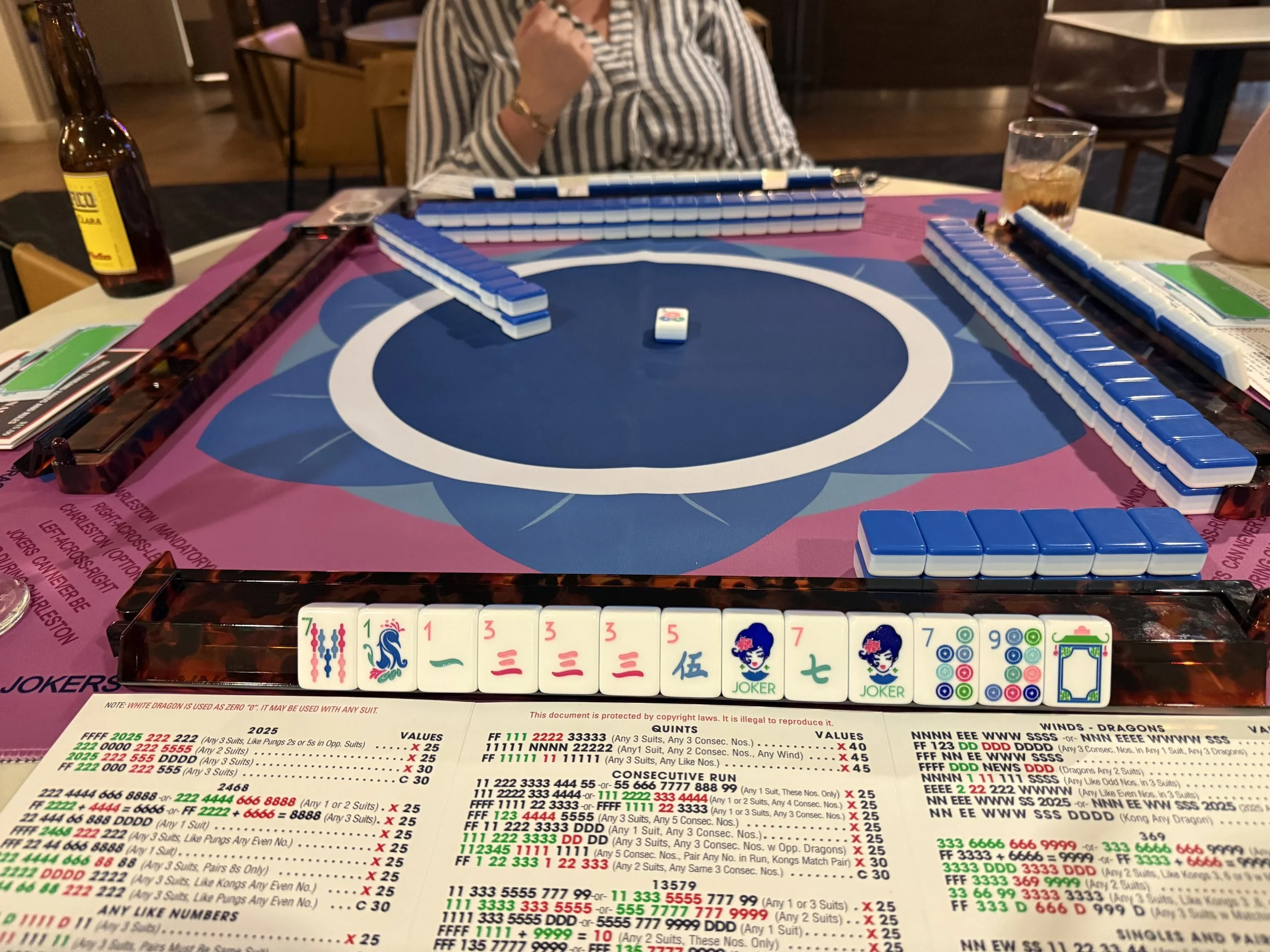
Our home base for the week was the Courtyard Marriott in Rancho Cucamonga, California. The lobby was a mahjong dream — plenty of tables perfectly sized for our mat, racks, and my Oh My Mahjong Lola tiles. On night one, a co-worker (and former student) and I met downstairs for a “quick” round of Siamese Mahjong that turned into… well, several hours. There was a happy hour special, DoorDash on standby — done and done.
Night 2
The next night, we pulled in another traveler, Blake, to learn the three-player version. Once we got a few hands going, a couple of curious hotel guests stopped by to watch. A woman and a man (we’ll call him Roger) recognized the game right away. Roger lit up, explaining that they played Chinese mahjong, not American. I admitted I only vaguely understood the difference: one uses the NMJL card; the other doesn’t. Easy enough, right?
East Meets West
Roger asked to join, and we figured, why not? We warned him we didn’t know Chinese rules but were happy to give it a go. We started with a Charleston and a courtesy pass — our comfort zone — then began to draw and discard. Mid-game, Roger asked how long a typical hand takes. I told him about twenty minutes for experienced players. He looked shocked. Thirty seconds later, he called mahjong.
Turns out, Chinese mahjong follows a simpler structure — sets of four and a pair, usually pungs, chows, or kongs. Blake looked at me like, “What game are we playing that’s so much harder?” We rolled into another round, and Roger promptly won two more hands in a row. Clearly, our worlds had collided; East met West, and we were outmatched.
It Got Weird
While Roger was charming (and a bit too insistent on buying us drinks), things took a slightly uncomfortable turn. He guessed our ages, shared that he stayed at this hotel often, and just generally gave off “too familiar, too fast” energy. When we finally wrapped up for the night, he followed us to the elevator and pressed the button for my floor. Let’s just say, I’ve seen way too many Netflix documentaries that start this way. Thankfully, my friend Kay was on a different floor, and we walked off together.
So yes, it was fascinating to learn how differently Chinese mahjong plays, and it definitely piqued my curiosity to explore it more. But at the end of the day, the American version, with all its strategy, defense, and delightful complexity, still feels like home to me.
If my path ever crosses Roger’s again, I’m sure he’d be happy to teach me another round. But just to be safe…I don’t think I can ever stay at the Courtyard Marriott in Rancho Cucamonga again.
Some of the links on this page are affiliate links, which means we may earn a small referral fee at no extra cost to you. Thank you for supporting Mockingbird & Magnolia!