Our favorite ways to practice American Mahjong, build confidence, and keep learning after your first class.
You did it! You took your first mahjong class, learned what all those beautiful little tiles mean, figured out how the Charleston works, and maybe even called your very first Mahjong.
And then you went home.
Now what?
One of the most common questions we hear at the end of our Mahjong 101 classes is, “Okay, I learned how to play. But what am I supposed to do next?”
And our answer is always the same: PLAY!
Seriously. The most important thing you can do after learning mahjong is to actually use what you just learned.
Because here’s the thing about mahjong: you can understand everything perfectly during class, but if you don’t practice, it’s surprisingly easy to forget it all. Suddenly you’re staring at your tiles wondering what a pung is, how does the Charleston work, and whether you were ever actually taught how to play this game.
So before you forget everything we just spent an entire class teaching you, here’s exactly what we recommend doing next.
Step 1: Order Your National Mah Jongg League Card
If you finished your first class thinking, “Okay, I can definitely see myself getting into this,” the first thing we recommend is ordering your very own National Mah Jongg League (NMJL) card.
The NMJL releases a new card each April with the official winning hands for the year in American Mahjong. It’s the card you’ll use when playing with most American Mahjong groups, so the sooner you get comfortable reading it, the better.
And here’s an important tip: Order your card directly from the National Mah Jongg League.
There are all kinds of unofficial and lookalike cards out there, so buyer beware. If you want the official card, your safest bet is to go straight to the source.
You can order it here: www.nationalmahjonggleague.org
And yes, we know. The website looks like it hasn’t been updated since approximately the invention of the internet.
But we promise, it’s legitimate. That’s really where you need to go.
Ordering directly also helps you stay connected to the League as the official source for rules information and clarifications.
Our recommendation: If you think you’re going to continue playing American Mahjong, go ahead and order the official NMJL card. But if you’re still testing the waters, don’t let not having a card stop you from practicing!
Step 2: Start Practicing With I Love Mahj
Now that we’ve talked about your card, let’s talk about what we think is the single most important thing you can do after your first mahjong class: actually play the game.
And no, you don’t need three friends, a beautiful tile set, or a standing Thursday night mahjong group to get started.
That’s where I Love Mahj comes in.
We recommend it to every single one of our students, and it’s something Brooke and I personally use every day.
Sometimes we play independently. Sometimes we play together. And sometimes you just need to squeeze in a game between all the other things life expects you to do when you’d rather be playing mahjong.
Even better, you can use our code MOCKINGBIRD to get three weeks free! We’ll share more about that below, but even if you only use those three weeks, we think it’s worth signing up.
Affiliate disclosure: Mockingbird & Magnolia is an affiliate partner of I Love Mahj. We may earn a commission when you subscribe through our referral link. We recommend this platform because we personally use and enjoy it and believe it’s a valuable resource for our students.
Start Practicing With I Love Mahj | Code MOCKINGBIRD
The platform lets you practice with computer opponents (bots), play online with friends, join groups, and participate in live games. There are also organized tournament opportunities for players who enjoy a little competition.
They offer their own mahjong card that you can download and print directly from their website, so you can participate in online games and practice exercises while you’re waiting on your official NMJL card to come in.
Where We Recommend Starting: The Exercise Room
Once you’ve signed up, don’t feel like you need to jump straight into playing a full game.
I Love Mahj has several different exercises designed to help you develop your skills. And while they’re all worth exploring eventually, there are two we specifically recommend to our beginners.
Exercise 1: Make a Hand
This is where we’d start.
I Love Mahj shows you a line from the mahjong card, and your job is to select the tiles needed to make that exact hand.
You can work your way through the card one line at a time, actually building each hand with virtual tiles.
It’s simple, but it’s one of the most helpful exercises for someone who just learned how to play American Mahjong.
Why do we love this exercise so much?
Because there’s a big difference between looking at a line on the card and understanding what that hand actually looks like when it’s sitting on your rack.
You might understand what the numbers and colors on the card represent, but when you have to select the actual tiles to build that hand, it starts to click.
You’re connecting what you see on the card to the tiles you’ll be looking for during a game.
And that’s a HUGE part of learning American Mahjong.
Exercise 2: Charleston Practice
Once you’re feeling more comfortable reading the card, the next exercise we’d recommend is Charleston Practice.
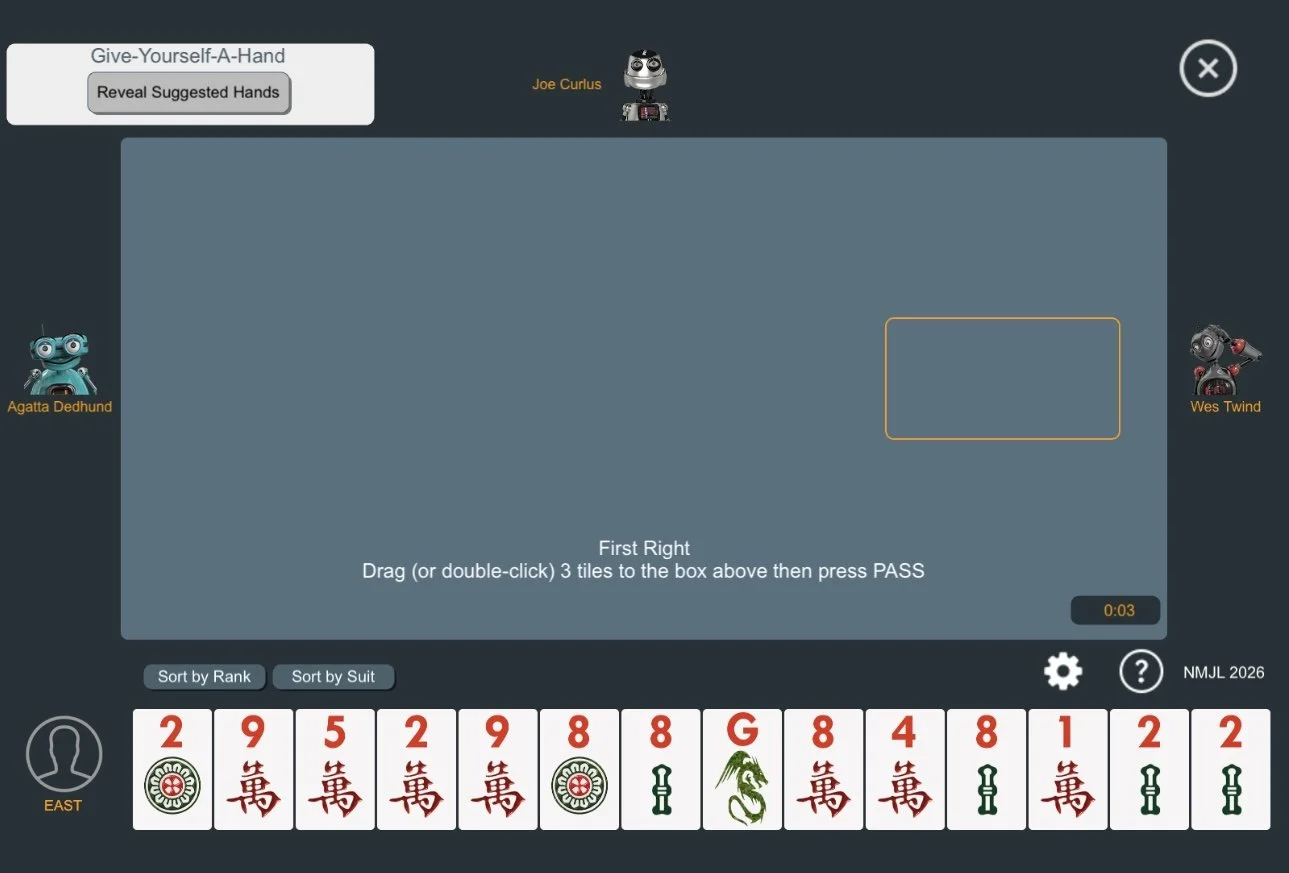
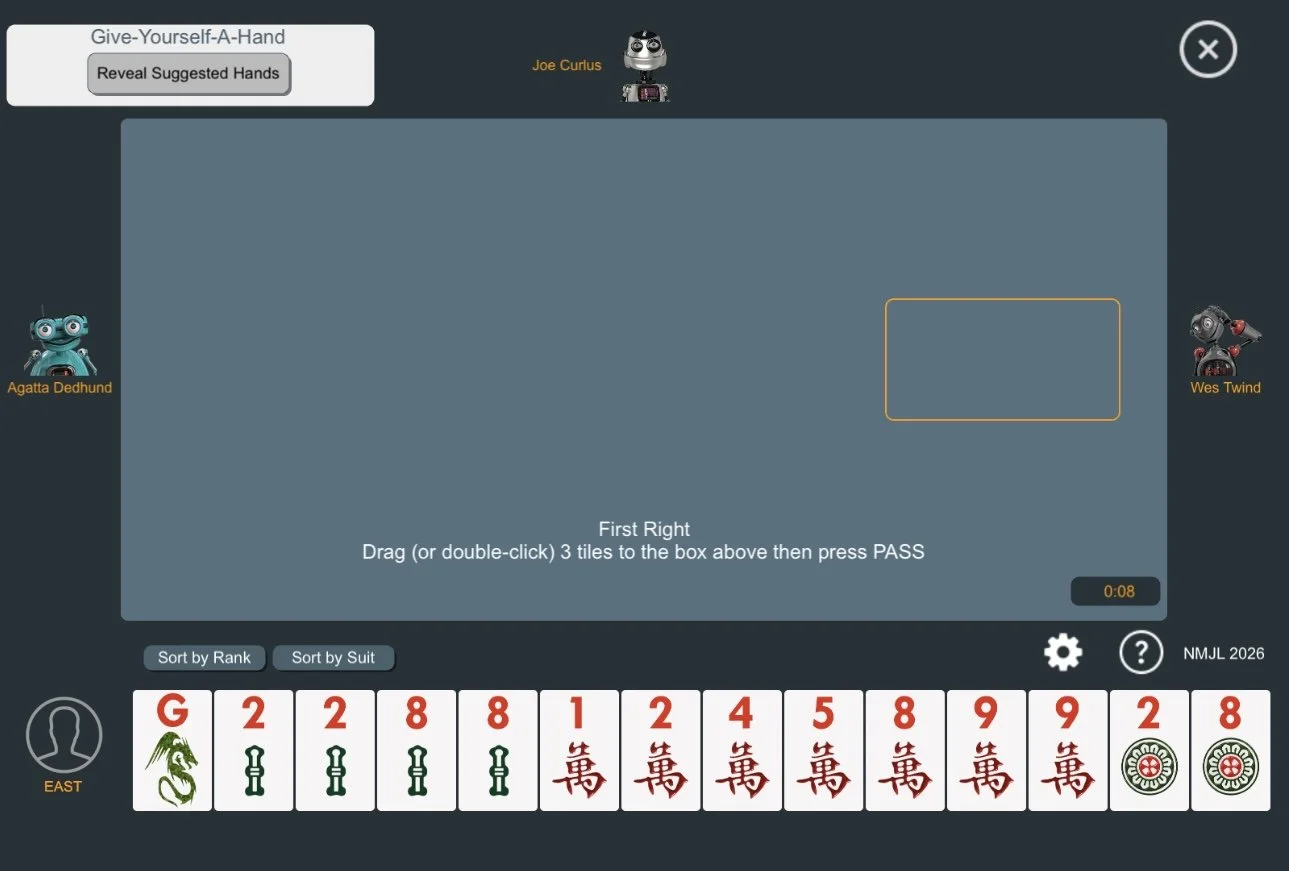
An unsorted rack in the Charleston Practice section of I Love Mahj.
If you took a class with us, you probably remember one of the very first things we taught you to do after receiving your tiles: organize your rack!
There’s a reason for that. When your tiles are all jumbled together, it’s much harder to recognize patterns and identify potential hands.
Charleston Practice is a great way to work on that skill.
When you start the exercise, you’ll see a rack full of tiles, all mixed up, just like when you’re first dealt your tiles at the table.
Here’s how we recommend using it:
Start by clicking “Sort by Suit.” This organizes your tiles so you can more easily recognize patterns in your rack.
Study your tiles before asking for help. Look at your card and identify which hands you think are the strongest possibilities based on the tiles you’ve been dealt.
Click “Reveal Suggested Hands.” The Give-Yourself-A-Hand feature will show you potential hands that work with your current tiles.
Compare its suggestions to your own choices. Did you identify the same hands? Did the system find an option you overlooked?
Keep going through the Charleston. As you make passes and receive new tiles, repeat the process. Pay attention to how your strongest options change as your rack changes.
Our Teacher Tip: Don’t Peek at the Answer Key!
Remember studying for tests in high school with flashcards? You’d read the question, try to come up with the answer yourself, and then flip the card over to see if you got it right.
That’s exactly how we want you to approach Charleston Practice.
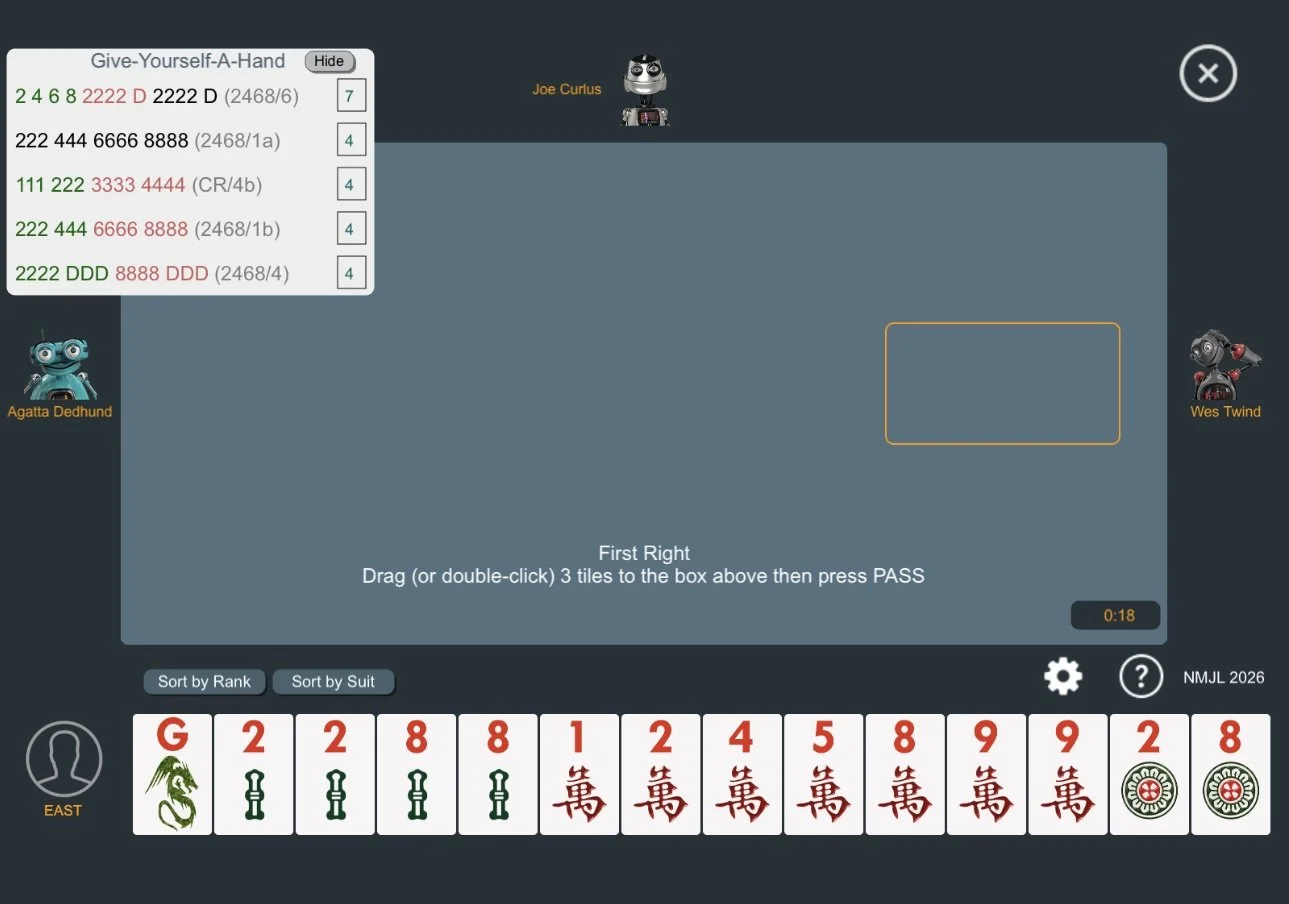
The screen you see when you click “Reveal Suggested Hands.”
It’s tempting to immediately click “Reveal Suggested Hands” and let the computer tell you what to do. But if you do that every time, you’re skipping the part that’s actually helping you learn.
Make yourself do the thinking first.
Look at your tiles. Study the card. Decide which hands you think give you the best chance. Then use the system’s suggestions to check your thinking.
And don’t get discouraged if your choices don’t match! That’s part of the learning process.
Our Teacher Tip: When in Doubt, Count!
One of the things we tell our students all the time is “When in doubt, count!”
If you’re staring at your rack trying to decide which direction to go, start by counting how many tiles you have that support each potential hand on the card.
Maybe you’ve got six tiles toward one hand and only four toward another. That’s a pretty good clue about which direction might make more sense.
But what if you’ve got six tiles toward two different hands?
Pick a lane and go!
Seriously. Sometimes beginners get so caught up trying to figure out the perfect hand that they struggle to make any decision at all.
This is where I Love Mahj’s suggestions can be especially helpful.
When you click “Reveal Suggested Hands,” you’ll notice a number beside each suggested hand.
That number tells you how many tiles on your rack currently count toward completing that line on the card.
So if you see a 7 beside a hand, that means seven of your current tiles can be used toward that hand.
It’s a great way to check your own counting and see if you overlooked another possibility.
And remember, the hand you start pursuing doesn’t have to be the hand you finish playing. As new tiles come your way, you can always reevaluate and change direction.
The goal isn’t to make the perfect Charleston decision every time. It’s to get better at recognizing your options and making decisions without second-guessing every pass.
The more you practice this, the faster you’ll get at recognizing patterns and making decisions.
What About the Other Exercises?
You’ll notice that I Love Mahj has several other exercises available, including one called “What Hand Is That?”
It’s a great exercise, but we wouldn’t recommend starting there if you’ve just finished your first mahjong class.
“What Hand Is That?” helps you practice identifying which hands your opponents might be playing based on their exposed tiles. It’s a fantastic way to start developing defensive skills, but that’s a different stage of learning.
When you’re brand-new, you’ve already got plenty to think about just managing your own rack!
Before you start worrying about what everyone else at the table is doing, we want you to get comfortable with recognizing patterns on the card and making Charleston decisions without overthinking every tile.
How Much Does I Love Mahj Cost?
Here’s another reason we love recommending it: it’s an affordable way to get a whole lot of mahjong practice.
After the free trial, the regular subscription options have been listed as $6 per month or $60 per year (current as of October 2026). Check the platform for current rates before choosing a subscription.
And here’s what we always tell our students: even if you only use the three free weeks, we think it’s absolutely worth signing up.
You can get a tremendous amount of practice in three weeks, especially if you make it a point to play a little each day.
Try I Love Mahj Free for 3 Weeks with Code MOCKINGBIRD
If you’re wondering how much you should practice, we recommend starting small. You don’t need to carve out hours every day. Even 10–15 minutes of focused practice can help reinforce what you learned in class.
Step 3: Find Your Mahjong People
One of our favorite things about mahjong isn’t actually the game itself. It’s the people you meet along the way.
Maybe you’re lucky enough to have friends or family who already play, and you’ve got a group ready to welcome you to the table. Amazing! But what if you don’t know a single other person who plays mahjong? Don’t worry. You are definitely not alone.
Our advice? Start looking for your local mahjong community.
One of the easiest ways to do that is through Facebook. Try searching for “mahjong” or “mah jongg” along with your city, town, or region. You might be surprised how many people in your area are already playing!
Local mahjong Facebook groups are a fantastic resource for finding people to play with, discovering classes and open play opportunities, and keeping up with what’s happening in your local mahjong community.
Mahjong instructors and event organizers frequently share upcoming classes, social events, and tournaments in these groups.
And don’t be afraid to introduce yourself! A simple post saying, “Hi! I just learned how to play American Mahjong and would love to find some people to practice with,” might be all it takes to find your next mahjong group.
Playing Mahjong in Northwest Arkansas?
If you’re local to us here in Northwest Arkansas, here are two Facebook communities to check out:
Finding your mahjong people is one of the best parts of learning the game. And who knows? Your next good friend might be someone you haven’t even met yet.
Step 4: Get Back to a Real Mahjong Table
Online practice is fantastic, and we genuinely believe it can help you become a better player.
But there’s one thing it can’t completely replace: sitting around a table with other people.
We hear new players say things like, “I’m going to practice a little more before I come to open play.”
And we understand! It can feel intimidating to sit down with people who have been playing longer than you.
But here’s the thing: you don’t have to be a great mahjong player to start playing mahjong.
You just need to know the basics, be willing to learn, and give yourself permission to make mistakes.
Should You Try Open Play or Mahjong 102?
Open play is a great next step if you already understand the basics and want more opportunities to play. These gatherings are generally intended for people who know how to play, rather than a structured lesson. An instructor or host may be available for occasional rule clarification, but you should be comfortable playing a game without step-by-step instruction.
Mahjong 102 is for players who want more guided instruction. In our Mahjong 102 classes, we build on the foundation you learned in Mahjong 101 and spend more time working with the full NMJL card, Charleston strategy, decision-making, and learning when to change direction.
You don’t have to choose one or the other forever. Both can help you build confidence, and they serve different purposes.
Because knowing how to play the game and feeling confident playing it are two different things. That confidence comes with experience.
The Most Important Thing? Keep Playing!
If you remember only one thing from this article, let it be this: don’t let everything you just learned disappear because you waited too long to play again.
Order your card. Spend some time practicing online. Find your mahjong people. Get yourself back to a table.
You don’t need to know every hand on the card. You don’t need to make the perfect Charleston decisions. And you definitely don’t need to win every game.
You just need to keep playing.
We love watching our students go from being completely overwhelmed by a rack full of tiles to confidently making decisions and calling Mahjong.
And we can’t wait for you to get there, too.
Mahj Y’all!
Sydney & Brooke
Mockingbird & Magnolia